
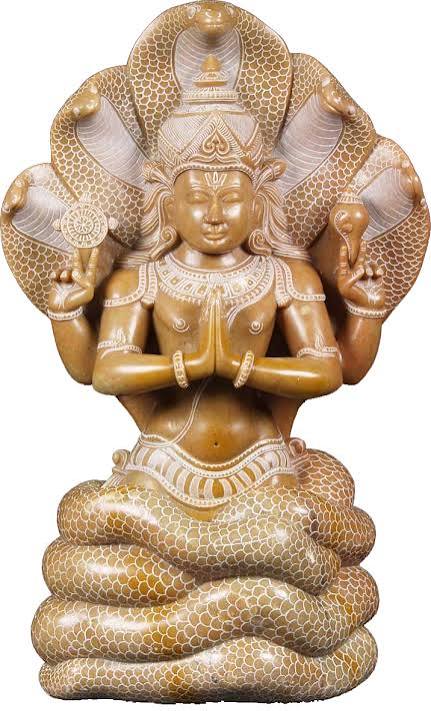
योगेन चित्तस्य पदेन वाचां । yOgEna cittasya padEna vAcAm
मलं शरीरस्य च वैद्यकेन ॥ malaṁ sarIrasya ca vaidyakEna
योऽपाकरोत्तं प्रवरं मुनीनां । yo’pAkarOttaṁ pravaraṁ munInAṁ
पतञ्जलिं प्राञ्जलिरानतोऽस्मि ॥ patañjaliṁ prAñjalirAnatO’smi
“I bow with folded hands to Sage Patanjali, the most exalted of sages, who removed the impurities of the mind through Yoga, refined the defects of speech through Grammar, and cleansed the illnesses of the body through Medicine (Ayurveda)”
This is a prayer to patanjali that we chant before our yOga practice.While we have been chanting this prayer for a long time now, only recently I observed the import of this shlOka in the way this define what yOga is for, through the author of this shlOka, bhOjarAjA.
yOga sUtrAs of patanjali and bhagavad gItA in mahAbhArata of vyAsA are the foremost treatises on the praxis of yOga. yOga sUtrAs can be said to be a condensation/ distillation of the elaborate gItA.
In today’s context, the practice of yOga got popular more as a form of physical exercise, and as a cure for bodily afflictions, that many consider yOga almost synonymous to the practice of AsanAs. Given the current day context, entering in to the praxis of yOga as a form of treatment for bodily ailments is quite understandable. However, engaging with yOga primarily as a form of treating/ managing bodily afflictions is like using an advanced smart phone only for making and receiving phone calls (refer to another post link given at the end of this post).
The shlOka says योगेन चित्तस्य – “removed the impurities of the mind through Yoga”; and not “yOgEna kAyasya” (treating the diseases of the body). Our AsAn shrI raghu emphasizes that of the 190+ sUtrAs in yOga sUtrA, only about 30 odd sUtrAs are even connected to body. The rest are all about the mind and inner instruments/ phenomenon; and the same is the case with the aShta angAs of yOga* – only Asana and prANAyAma are connected to the practices/ observations related the body.
This is not to say that Asana or prANAyAma are not important. On the contrary, they are essential aspects in the practice of yOga, not only for the beginners, but for all practitioners, as only the body and the breath keeps me anchored to the reality of the current moment. However, if one approaches the practice with a clearer perspective, then one has the possibility of engaging with the every aspect of the practice, including Asana and prANAyAma, in a way coherent with the other angAs; else, one’s practice will be focused on the physical primarily (like that happens in a gym) and so, it be disjointed from the core ideas of the praxis of yOga.
Thus, the real practice of yOga is not isolated from one’s engagements in daly life. It is in the engagements of daily life – in one’s capacity to observe oneself and the world around, as one engages with the challenges of daily life.
Learning yOga, therefore, is not about mastering X No of postures, but is about making connections between the way I practice Asana and the way I behave in the world. The real practice is a constant endeavor (प्रयत्नम् – prayatnam) to touch the limits of one’s capabilities and stretching it a little, at a time, — of my body (Asana), of my breath (prANAyAma), of ways of engaging with the world (yama), of ways of engaging with one’s inner anchors (niyama).
* aShta angAs of yOga
- यम – yama – social disciplines
- नियम – niyama – personal disciplines
- आसन – Asana – attentiveness to body and postures
- प्राणायाम – prANAyAma – attentiveness to breath and its regulations
- प्रत्याहार – pratyAhAra – turning the gaze inwards
- धारण – dhAraNa – single pointed attention on to the object of inquiry
- ध्यान – dhyAna – uninterrupted attention on the object of inquiry
- समाधि – samAdhi – absorbtion/ complete integration on to the object of inquiry
{This post is, in a way, a continuation of an early post titled The real pursuit in the practice of yoga”}
Responses